The Letters of Lieutenant Kenneth G. Jeanneret
This post is also available in:
 Nederlands
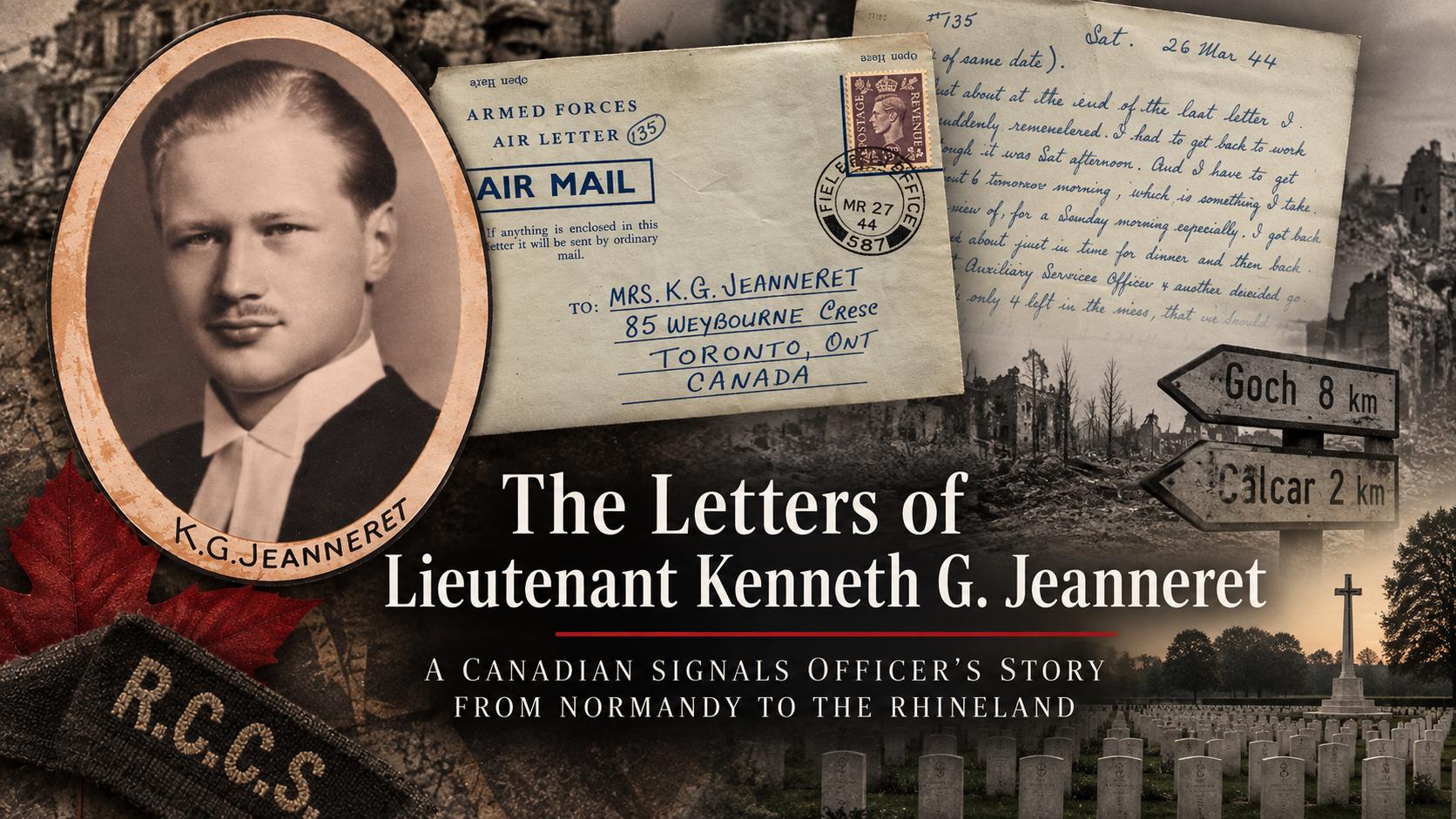
The Story of Lieutenant Kenneth Geikie Jeanneret, Royal Canadian Corps of Signals, Attached to the Essex Scottish Regiment
“My job is certainly not very exciting.”
At first glance, it is an innocent remark, casually written in a letter to his wife, Rita, from England. When Canadian Lieutenant Kenneth Geikie Jeanneret penned these words in early 1944, he could never have imagined that little more than a year later he would lose his life in one of the bloodiest Canadian battles of the Second World War. His duties as a Signals Officer rarely kept him behind a desk. Instead, they took him to the most dangerous parts of the battlefield, where radio communications had to be maintained under enemy fire, tanks became bogged down in thick mud, and fierce German counterattacks continually threatened to halt the Canadian advance. More than eighty years later, Kenneth’s story began for me in an unexpected place—not in an archive or museum, but on eBay. Among hundreds of medals, photographs, and military documents was a small collection of Canadian Air Letters. They had been written by an unknown lieutenant to his wife in Toronto.
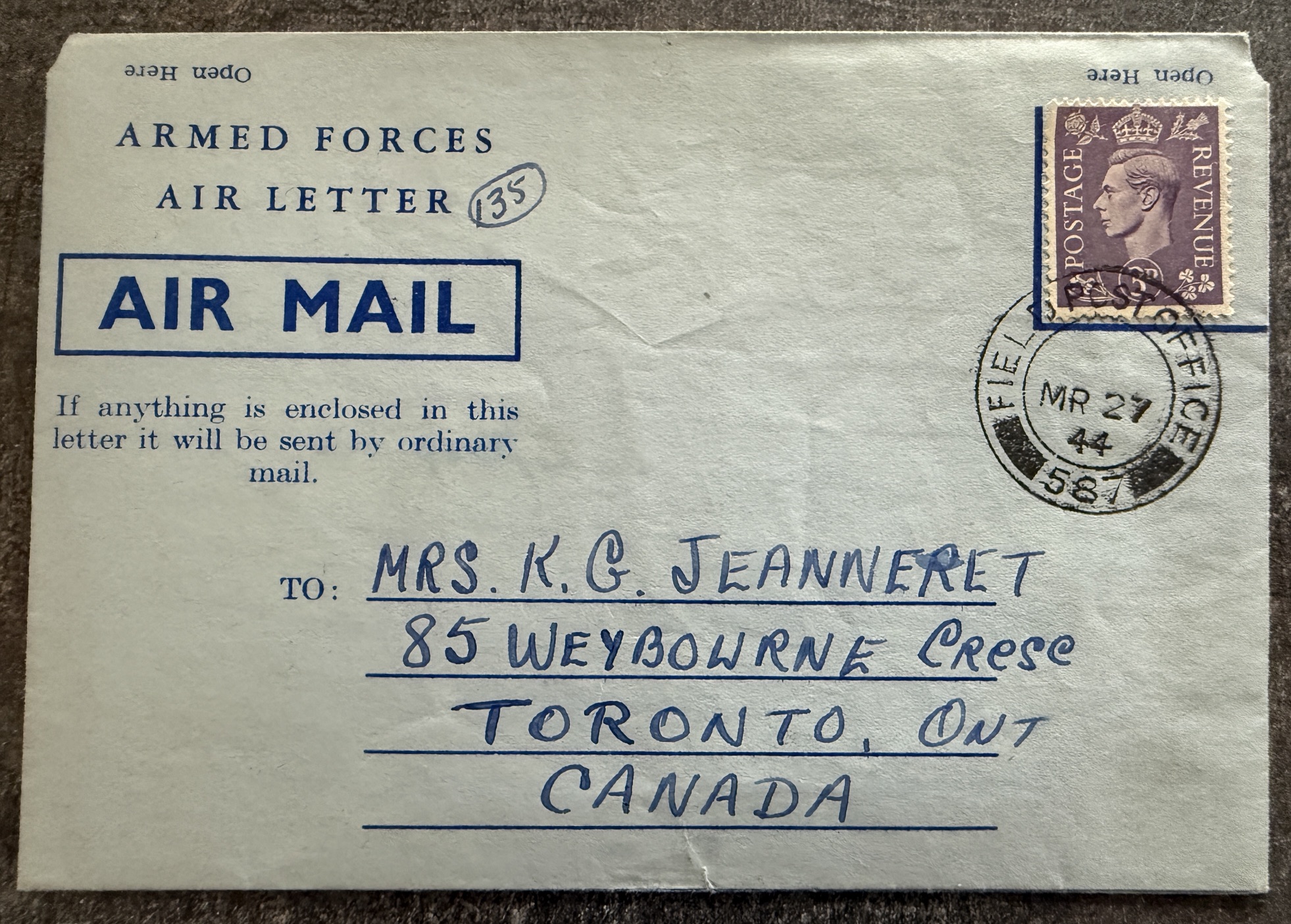
Original Air Mail letter written by Lieutenant Kenneth G. Jeanneret to his wife, Rita, in Toronto. © Joël Stoppels
Only after carefully unfolding the first letter did I realize that I had acquired far more than a small bundle of old papers. In my hands was the deeply personal story of a young Canadian officer who wrote to his wife about train journeys, evenings at the cinema, military training courses, and everyday life in wartime England. There was very little mention of the war itself. Ironically, that is precisely what makes the letters feel so immediate and personal. They invite the reader to look beyond the signature and discover the man behind the uniform. That curiosity soon grew into an extensive research project. The letters were only the beginning. They were followed by Jeanneret’s complete service file, Canadian newspaper articles, regimental histories of the Essex Scottish Regiment, firsthand accounts from veterans of the Fort Garry Horse, and official military reports. Piece by piece, not only did Kenneth Jeanneret’s life story emerge, but so too did a detailed reconstruction of his final days in the war. The picture that gradually came into focus was that of an intelligent young lawyer from Toronto who set aside a promising civilian career to serve as an officer in the Royal Canadian Corps of Signals. He was eventually attached to the Essex Scottish Regiment, where he became responsible for maintaining communications between the forward rifle companies, Battalion Headquarters, supporting artillery, and the accompanying tank units. It was a role that rarely attracted attention, yet in the chaos of battle it was absolutely indispensable. Without reliable communications, even the best-planned operation could quickly descend into confusion.
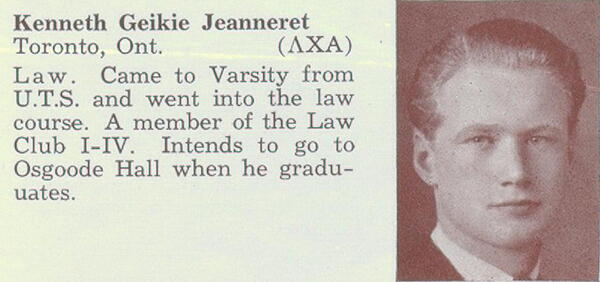
Kenneth Geikie Jeanneret as a law student at the University of Toronto, pictured in the 1939 Torontonensis yearbook. At the time, he was a member of the Lambda Chi Alpha fraternity and the University Law Club. After graduating, he continued his legal studies at Osgoode Hall Law School. © Canadian Virtual War Memorial
A future that took a different course
Kenneth Geikie Jeanneret was born on 12 December 1918 in Toronto, Ontario. Raised in an intellectual family, he grew up in an environment that placed a high value on education and academic achievement. His father, Professor François Charles Archile Jeanneret, headed the Department of French at the University of Toronto and encouraged his son to pursue a university education of his own. Kenneth proved to be an outstanding student. In 1939, he earned his Bachelor of Arts degree from the University of Toronto before continuing his legal studies at Osgoode Hall Law School. Four years later, in 1943, he completed his law degree and was called to the bar. Everything suggested that he was destined for a successful legal career. His personal life also seemed to be falling into place. On 27 June 1942, he married Mary Rita Jeanneret. By then, the Second World War had already been raging for nearly three years, yet for many young Canadians Europe still seemed a distant battlefield. Nevertheless, shortly after his marriage, Kenneth made the decision to volunteer for military service. Instead of beginning his career in a law office, he exchanged civilian life for the uniform of the Canadian Army. Thanks to his education, intelligence, and analytical abilities, he was commissioned into the Royal Canadian Corps of Signals, the branch responsible for maintaining communications across the battlefield. It was a role that demanded technical expertise, sound judgement, and the ability to remain calm under immense pressure—qualities that Kenneth would demonstrate time and again throughout his military service.
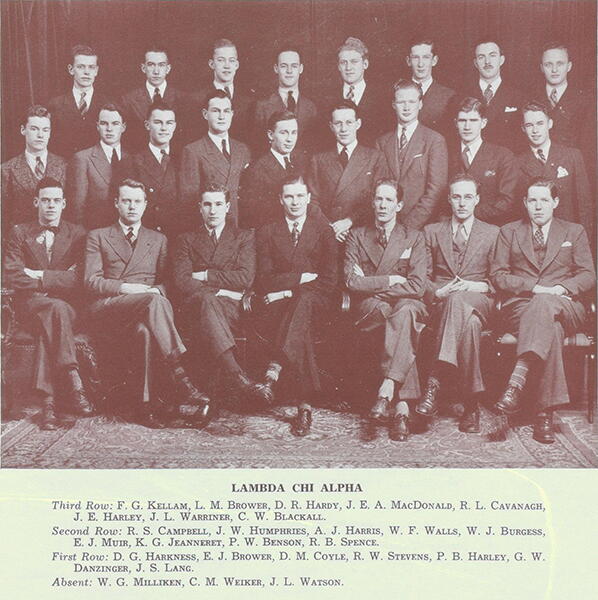
Group photograph from the 1939 Torontonensis, the University of Toronto yearbook, showing Kenneth G. Jeanneret together with fellow members of the Lambda Chi Alpha fraternity. © Canadian Virtual War Memorial
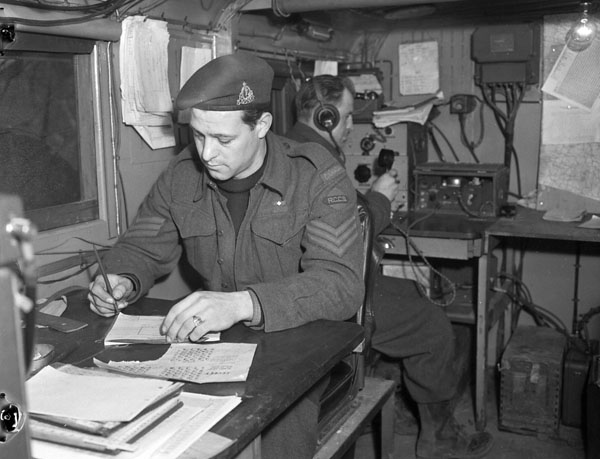
To an outsider, the Royal Canadian Corps of Signals may sound like little more than a technical support branch. In reality, however, the Signals Corps formed the nervous system of every Allied army. Without reliable communications, infantry, armour, artillery, and air support could not operate as a coordinated force. When radios failed or telephone lines were cut by shellfire, it was the Signals Officers who were responsible for restoring communications—often while under direct enemy fire. As a result, they frequently found themselves in some of the most dangerous positions on the battlefield.
Kenneth’s service record reveals how seriously he embraced his new profession. He completed an impressive series of specialist courses, covering everything from wireless communications and field telephone systems to the coordination of communications between infantry and armoured units. His instructors consistently described him as an intelligent and capable officer who approached his duties with enthusiasm and professionalism. They believed he possessed all the qualities required to become an outstanding Signals Officer.
At the time, no one could have imagined that the very skills for which he was so highly regarded would ultimately place him in the path of danger and, in the final months of the war, cost him his life.
Letters from England
Official documents tell us a great deal about Kenneth’s military career, but very little about the man himself. To discover that side of his story, we must turn to his personal letters. From the beginning of 1944, Kenneth wrote regularly to his wife, Rita. Surprisingly, the war itself was rarely the main subject of his correspondence. Instead, he wrote about train journeys across England, the military courses he attended, the officers he met, and the routines of everyday life at the various camps where he was stationed.
One of his earliest letters begins with an almost apologetic remark:
“My writing is going to be rather shaky.”
He was writing while travelling on a moving train to an American Signals School, where he had the opportunity to familiarize himself with the latest American communications equipment. With genuine curiosity, he described what he saw, compared it with British methods, and concluded that both armies had their own strengths and weaknesses. It is a perfect example of Kenneth’s analytical mind. Even in a personal letter to his wife, he remained an attentive observer, carefully weighing and comparing what he experienced.
What is perhaps even more striking is how little he thought of himself as a hero. Quite the opposite. In one of his letters he wrote, with a touch of self-deprecating humour:
“My job is certainly not very exciting.”
According to Kenneth, much of his work consisted of administrative duties. He explained that his non-commissioned officers handled most of the practical work, while he occupied himself with paperwork, training courses, and organizational responsibilities. To Rita, this must have sounded reassuring. Her husband appeared to be far removed from the dangers of the front line.
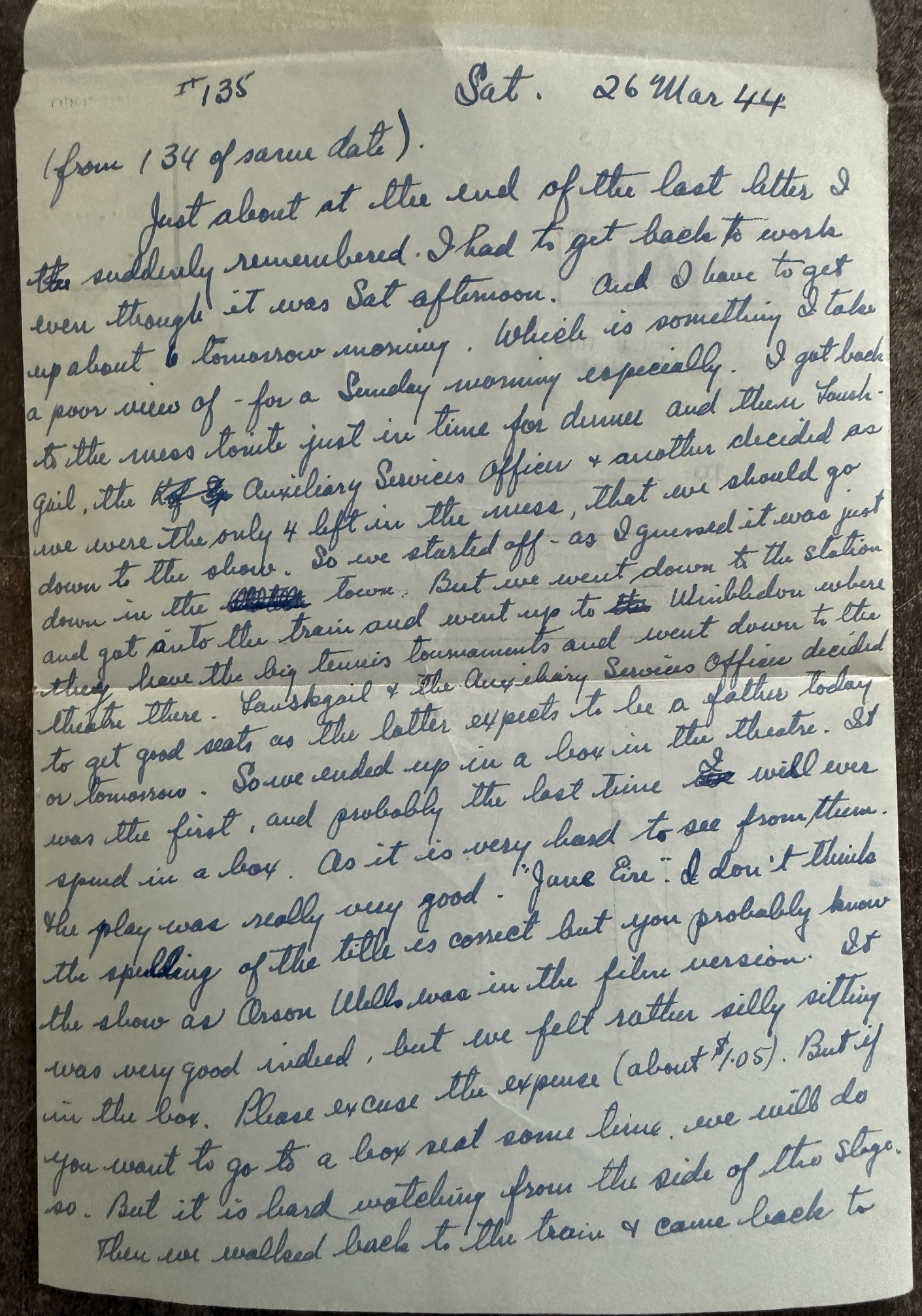
Original Air Mail letter written by Lieutenant Kenneth G. Jeanneret (Royal Canadian Corps of Signals) to his wife, Rita, in Toronto. In this letter, Kenneth recounts a rare moment of relaxation during his training in England, including a train journey to Wimbledon and an evening at the theatre to see Jane Eyre. It offers a fascinating glimpse into the everyday life of a young Canadian officer in the months leading up to D-Day. © Joël Stoppels
England, Normandy, and a remarkable escape
As the Allied preparations for the invasion of Europe gathered momentum in the spring of 1944, Kenneth Jeanneret’s life also began to change. His training as a Signals Officer was nearing completion, and the administrative duties he so often mentioned in his letters were gradually giving way to practical exercises and operational preparations. Even so, the war itself remained remarkably absent from his correspondence. Kenneth seemed to make a conscious effort to write about subjects that would reassure Rita. Rather than dwelling on the tension and uncertainty that he undoubtedly felt himself, he preferred to describe the ordinary routines of everyday life. It is precisely this quality that makes his letters so compelling. They reveal how young Canadian officers tried to preserve a sense of normality at a time when everyone knew that the crossing to continental Europe was only a matter of time. One recurring theme throughout his correspondence is the friends with whom he spent his free time. Kenneth frequently mentioned Bill, Luke, and, above all, Dave. Their names appear almost casually between the lines, as though he assumed Rita knew exactly who they were. In one letter, he describes an evening spent at the cinema with Dave and Bill. They met in the officers’ mess, took a taxi into town, watched a film, and rounded off the evening with a drink before returning to camp. For Kenneth, it was nothing extraordinary—simply an enjoyable evening in the company of good friends. It is only with the benefit of hindsight that this passage becomes so profoundly moving. Knowing how their story would end transforms these ordinary moments into treasured glimpses of lives that would soon be irrevocably changed by war.
Hier is een vloeiende Engelse vertaling die goed past bij de stijl van je artikel:
Sergeant W. Logan and Signalman A.E. Angel operating a Wireless Set No. 9, one of the standard radio sets used by Canadian Signals units to maintain communications between headquarters and frontline combat units. © Library and Archives Canada
The Dave mentioned in Kenneth’s letters was almost certainly Captain David Stephen Herbert Loughnan, who also served as an officer in the Royal Canadian Corps of Signals. Without either man realizing it, less than a year later they would both be killed during the same battle while trying to maintain communications within the battalion. The letters also reveal another side of Kenneth’s personality. He possessed a dry sense of humour and seemed rarely bothered by the inconveniences of military life. He regularly made light-hearted remarks about army life. He wrote that his sergeants carried out most of the practical work, while he sometimes found himself occupied more with paperwork than with military duties, and that his days were filled with lessons, training exercises, and administrative responsibilities. Looking back, those remarks take on an almost poignant meaning. The young officer who portrayed himself as someone who spent much of his time behind a desk would, only a few months later, be responsible for maintaining communications during some of the fiercest battles of the Canadian advance through Northwest Europe.
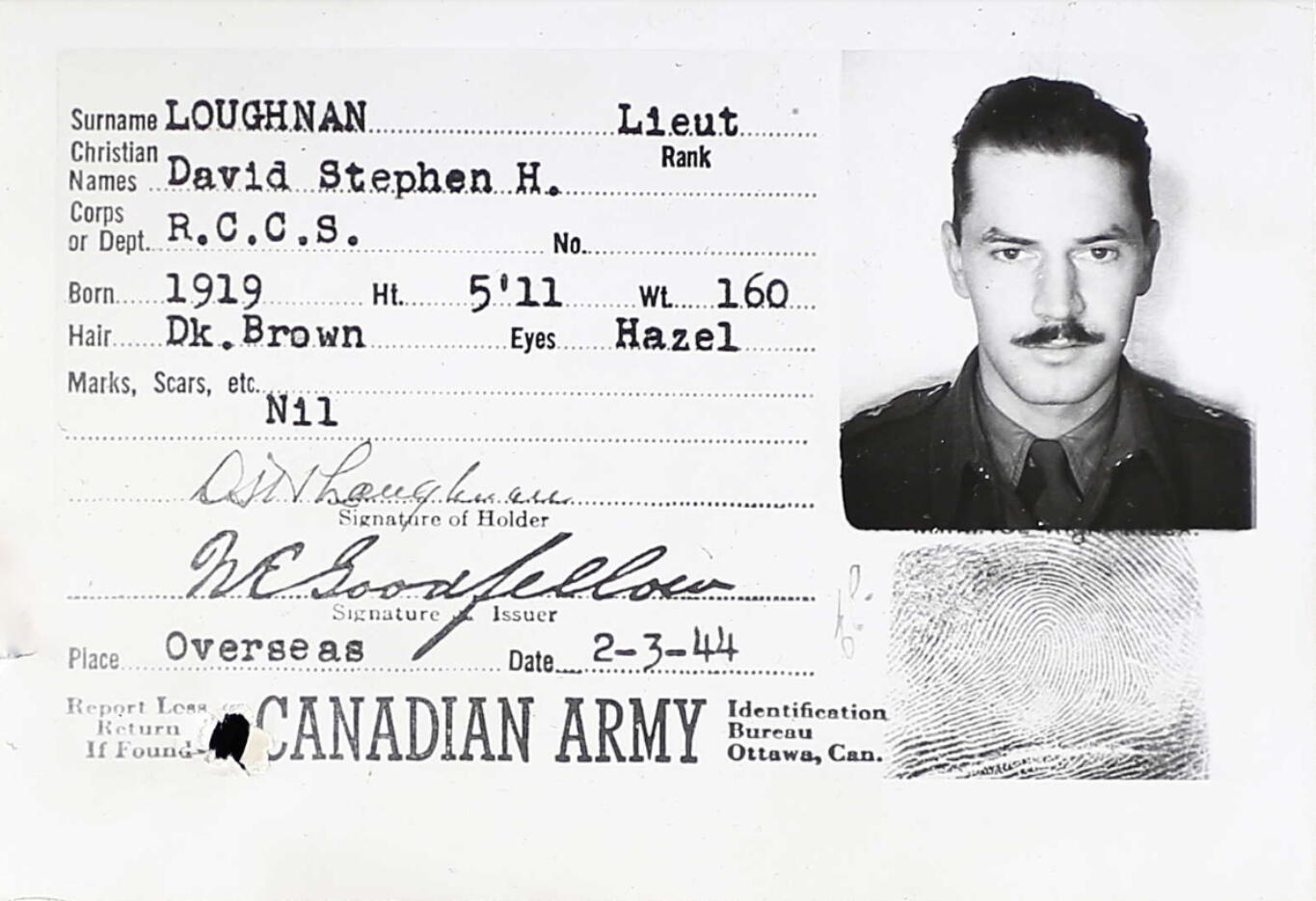
Lieutenant David Stephen Herbert Loughnan (Royal Canadian Corps of Signals), photographed for his Canadian Army identity card, issued on 2 March 1944. Loughnan was a close friend of Kenneth G. Jeanneret. He is mentioned several times in Kenneth’s letters to his wife, Rita; together they went to the cinema and spent many of their scarce moments of leave together in England. Less than a year later, both Signals Officers were killed during the fierce fighting along the Goch–Calcar Road on 19 February 1945. © Canadian Virtual War Memorial
To Normandy
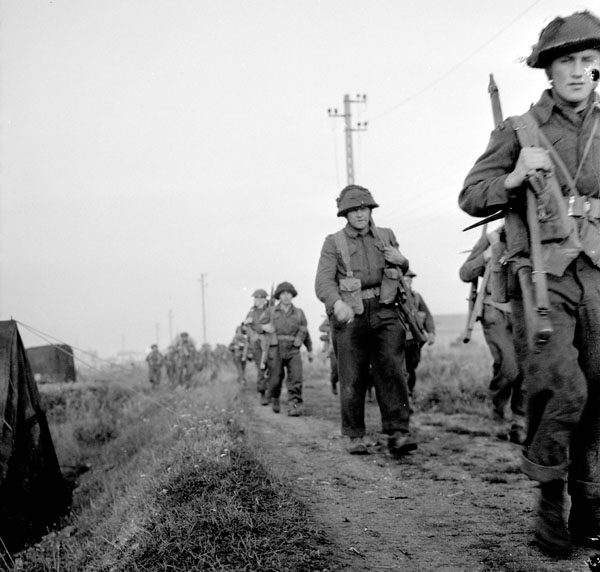
Infantrymen of The Royal Winnipeg Rifles advance across the fields near Ifs, south of Caen, during Operation SPRING on 25 July 1944. The attack formed part of the Allied effort to capture Verrières Ridge, where Canadian units suffered heavy casualties in some of the fiercest fighting of the Normandy Campaign. © Library and Archives Canada
After the Allied landings on 6 June 1944, it would be several more weeks before Kenneth and his unit crossed to France. By then, it had become clear that the fighting in Normandy was proving to be anything but the swift breakthrough the Allied planners had hoped for. Around Caen, British and Canadian forces had become embroiled in a brutal war of attrition, where every farmhouse, every hedgerow, and every rise in the landscape was fiercely defended by experienced German armoured and infantry units. When Kenneth finally arrived in Normandy, he was attached to the Essex Scottish Regiment, one of the infantry battalions of the 2nd Canadian Infantry Division.
His role as a Signals Officer required him to move constantly between Battalion Headquarters, the forward rifle companies, the artillery, and the tanks of the Fort Garry Horse. Unlike many infantry officers, he had no fixed position. Wherever communications were in danger of breaking down, that was where he was needed. As a result, he found himself in some of the most dangerous places on the battlefield during virtually every attack.
The Battle of Verrières Ridge
In July and August 1944, the Essex Scottish Regiment took part in the bitter fighting south of Caen, where German forces defended the strategically important Verrières Ridge with great determination. The area was transformed into a lunar landscape of shattered orchards, collapsed farmhouses, and shell-torn fields. German artillery and mortars covered virtually every Canadian movement, while snipers and machine-gun fire met every attempt to advance. During one of these engagements, Battalion Headquarters came under a German air attack. Kenneth suffered a wound to his foot. At first, it appeared to be only a minor injury, but the situation quickly deteriorated as the battalion was forced to withdraw under heavy pressure. Amid the confusion, Kenneth became separated from his unit together with a wireless truck and six men. To the Essex Scottish Regiment, he had simply disappeared. In the administrative chaos that inevitably followed such intense fighting, he was officially reported missing in action. For four days, no one knew what had become of him.
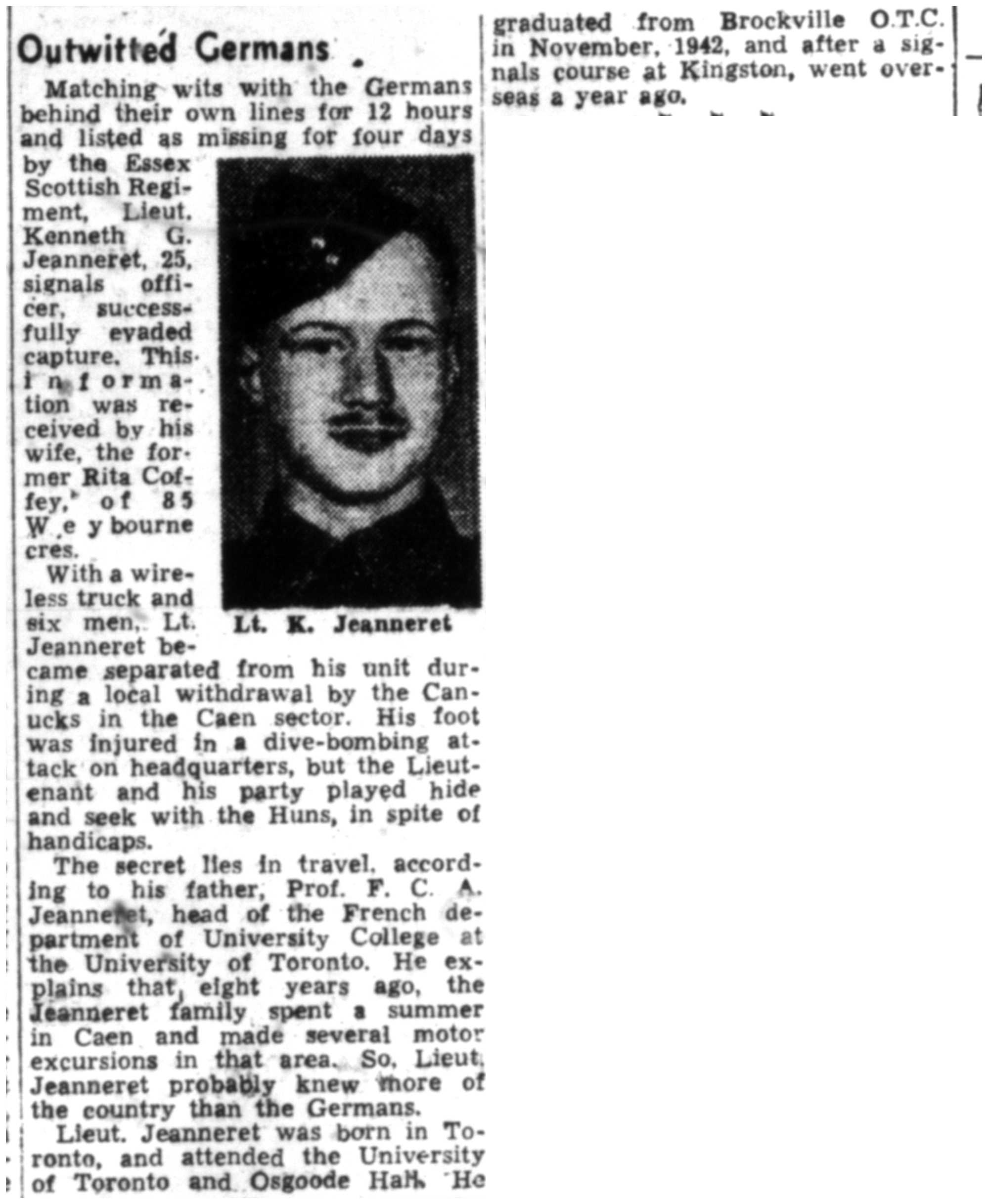
In September 1944, the Toronto Telegram reported on the remarkable escape of Lieutenant Kenneth G. Jeanneret. During the fighting in Normandy, he became separated from his unit together with six of his men and spent twelve hours behind German lines. Drawing on his familiarity with the countryside around Caen, the group eventually succeeded in making their way safely back to the Canadian lines. © Canadian Virtual War Memorial
For his family in Toronto, those four days must have been filled with anxiety. Meanwhile, newspapers in Canada began reporting the heavy casualties suffered by the Canadian divisions fighting around Caen. What exactly happened during those tense hours only became known later, when Canadian newspapers interviewed both Kenneth and members of his family. According to these accounts, he spent approximately twelve hours behind German lines. Together with his small group of six men and their wireless truck, he managed to remain concealed while constantly searching for a safe route back to the Canadian positions. His wounded foot made the journey even more difficult, yet he succeeded in avoiding capture.
One particularly fascinating detail came from his father, Professor François Jeanneret. He told journalists that, eight years before the war, the family had spent a holiday in Normandy. During that trip, they had made several long car journeys through the countryside around Caen, allowing Kenneth to become surprisingly familiar with the landscape. His father believed that Kenneth probably knew the area better than many of the German soldiers who had only recently dug in there. Whether that familiarity with the terrain truly proved decisive can never be known with certainty. What is certain is that Kenneth and his men eventually succeeded in finding their way back to the Canadian lines. For the Essex Scottish Regiment, it came as a tremendous relief. An officer who had been reported missing only days earlier suddenly reappeared. The Canadian press eagerly picked up the story. Newspaper articles described how the young Signals Officer had found himself behind German lines with his wireless truck and six men, and how, through determination, resourcefulness, and perseverance, he had fought his way back to his own unit.
The final months of the war
After the liberation of northern France, the Essex Scottish Regiment advanced through Belgium and the Netherlands toward Germany. During the autumn and winter of 1944, the fighting once again intensified as German resistance stiffened with every mile the Allies moved closer to the borders of the Reich. On 8 February 1945, Operation VERITABLE commenced, the major Allied offensive designed to clear the Rhineland of German forces and open the way to the River Rhine. Canadian and British troops crossed into Germany from the Nijmegen–Groesbeek bridgehead. The weather conditions were appalling. Days of relentless rain had turned the countryside into an almost impassable sea of mud. Every tank, armoured vehicle, and supply truck struggled to move forward, while roads were transformed into deep, clay-filled ruts in which vehicles frequently became hopelessly bogged down.
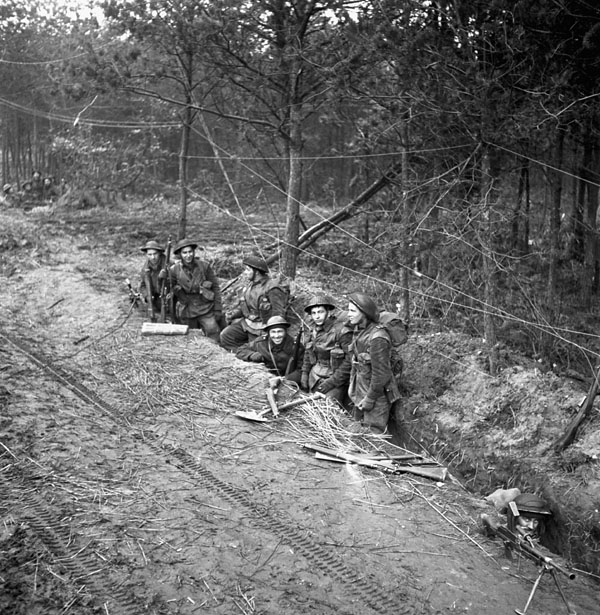
Soldiers of the Support Company, Le Régiment de Maisonneuve, take up positions near Nijmegen, the Netherlands, on 8 February 1945. From the Nijmegen bridgehead, Canadian forces prepared for Operation VERITABLE, the major Allied offensive that would launch the advance into the Rhineland just days later. © Library and Archives Canada
After more than a week of heavy fighting, the Essex Scottish Regiment was ordered on 19 February 1945 to attack the German positions along the Goch–Calcar Road. On paper, the plan appeared straightforward. The forward companies would be carried to their start positions in Kangaroos—armoured personnel carriers (APCs)—supported by Sherman tanks of the Fort Garry Horse. A massive artillery barrage was intended to break the German defences before the infantry advanced to capture the farm complexes at Göttern and Brunshof. Almost from the outset, however, it became clear that reality would prove very different. The thick mud slowed the Kangaroos and the tanks from the moment they crossed the start line. Some vehicles could barely move forward, while others became completely bogged down before they had covered any significant distance.
As a result, the infantry was forced to dismount much earlier than planned and advance several hundred metres across open ground. The Germans, belonging to the 12th Parachute Reconnaissance Battalion (12. Fallschirmjäger-Aufklärungs-Abteilung), had quickly recovered from the Canadian artillery barrage and opened devastating fire with machine guns, mortars, and 8.8 cm guns. At the same time, it became apparent that powerful armoured reserves from the Panzer Lehr Division and the 116th Panzer Division were positioned behind the forward German lines. Canadian intelligence had underestimated their presence. Within a short time, the carefully planned assault descended into complete chaos. Companies lost contact with one another. Tanks became separated from the infantry. Kangaroo armoured personnel carriers moved in the wrong direction. Radio communications failed one by one. For Kenneth Jeanneret, this was the moment when his most important task truly began.
The collapse of communications
While other officers remained with their own companies, Kenneth was required to move constantly across the battlefield. His work took place in the dangerous no-man’s-land between the infantry, the tanks, and Battalion Headquarters. Major Bruce MacDonald of the Fort Garry Horse later recalled just how important Kenneth’s role was at that critical moment. When the Kangaroo armoured personnel carriers began following the wrong tanks and the attack threatened to stall, it was Kenneth who managed to put things right. MacDonald simply recorded:
“Lieut. Jeannerette got this straightened out.”
Later that afternoon, Kenneth found himself with a group of tanks from the Fort Garry Horse. Together with Major MacDonald, he took cover in a shallow slit trench alongside the Goch–Calcar Road. By then, German snipers had occupied several nearby farmhouses and kept every movement under fire. As shells exploded around them, the men attempted to deepen their trench.
MacDonald would remember those hours for the rest of his life. Reflecting on Kenneth’s conduct, he later wrote:
“Lieut. Jeannerette, whose conduct all this time was beyond praise…”
It is a remarkable tribute. MacDonald was an experienced tank officer who had witnessed countless acts of courage throughout the war. That he described Kenneth’s conduct as “beyond praise” speaks volumes about the impression the young Signals Officer made on those around him. While digging the trench, Kenneth was wounded for the first time when a German sniper’s bullet struck his wrist. Despite the pain, he remained calm. He attempted to reach a nearby slit trench where his wound could be dressed. As he rose and made the dash across the open ground, another shot rang out. This time he was hit in the abdomen. MacDonald rushed to his side and administered his own morphine syrette in an attempt to ease Kenneth’s pain. There was little else the men could do. Around them, the situation was becoming increasingly desperate. German tanks had by then penetrated deep into the Canadian positions, while German soldiers of the 12. Fallschirmjäger-Aufklärungs-Abteilung systematically attacked the isolated Canadian groups one by one.
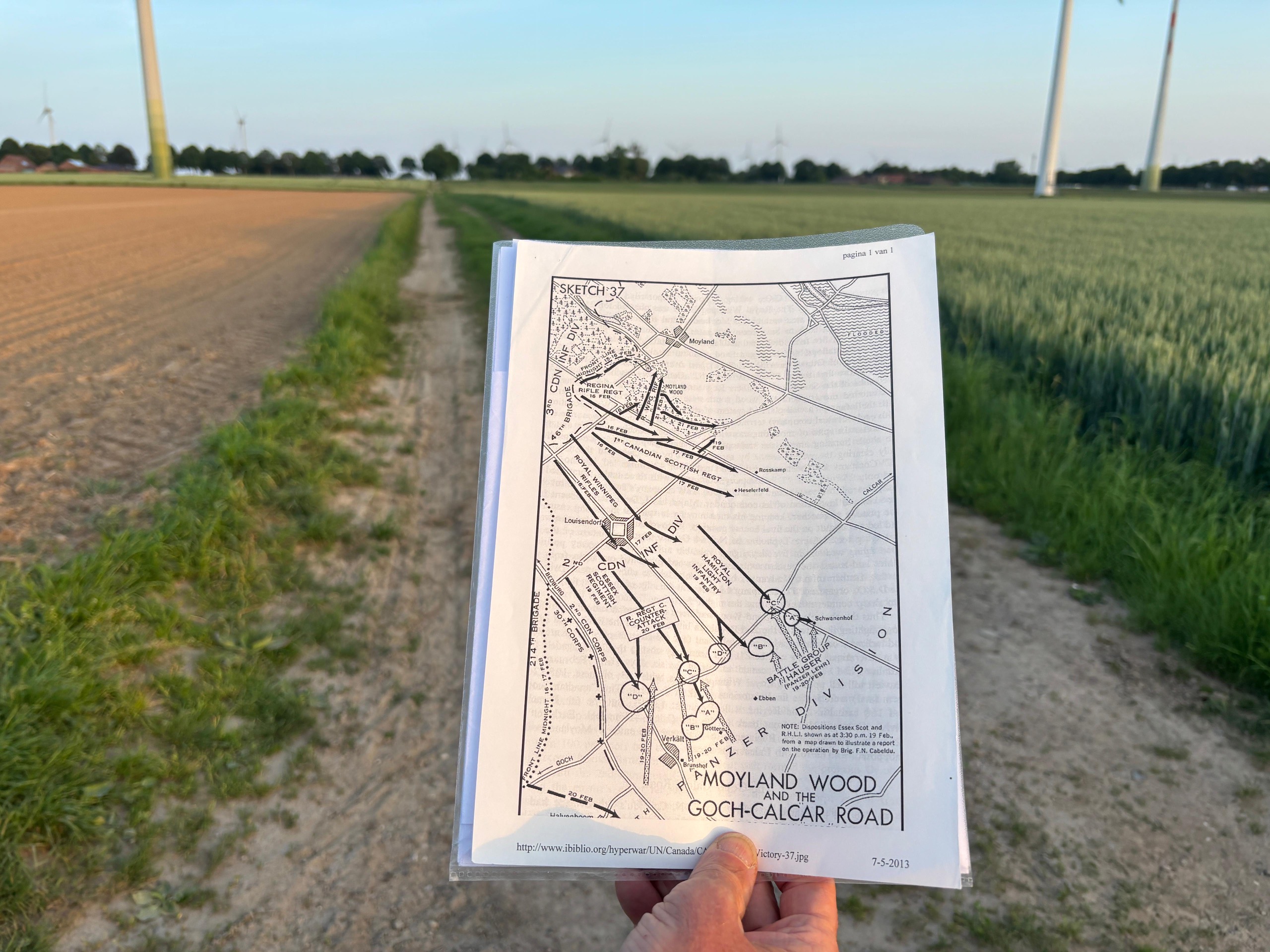
Map of the fighting around Moyland Wood and the Goch–Calcar Road, photographed at the location where the assault took place on 19 February 1945. Here, the Essex Scottish Regiment, the Royal Hamilton Light Infantry, and supporting Canadian armoured units fought their way through the German defences during Operation VERITABLE. It was during these fierce battles that Lieutenant Kenneth G. Jeanneret was mortally wounded. © Joël Stoppels
Battalion Headquarters lost virtually all contact with the forward companies and eventually became surrounded itself. The official battle report describes how officers became casualties, radio equipment was lost, and the battalion’s command structure almost completely collapsed. The battle quickly degenerated into a series of small, isolated engagements, with each group forced to fight on its own. As evening approached, German infantry also closed in on the slit trench where Kenneth lay. Hand grenades were thrown, and the surviving Canadians were running critically low on ammunition. Eventually, the remaining men were taken prisoner. Kenneth Geikie Jeanneret succumbed to his wounds. He was only twenty-six years old. The tragedy was compounded by the fact that his friend, Captain David Stephen Herbert Loughnan, with whom Kenneth had enjoyed a carefree evening at the cinema just a year earlier, was also killed that same day during the same battle while attempting to maintain communications within the regiment. The two young officers, who had first met during their training in England and had served together from the Normandy campaign onward, ultimately lost their lives on the same day during one of the fiercest engagements of Operation VERITABLE.
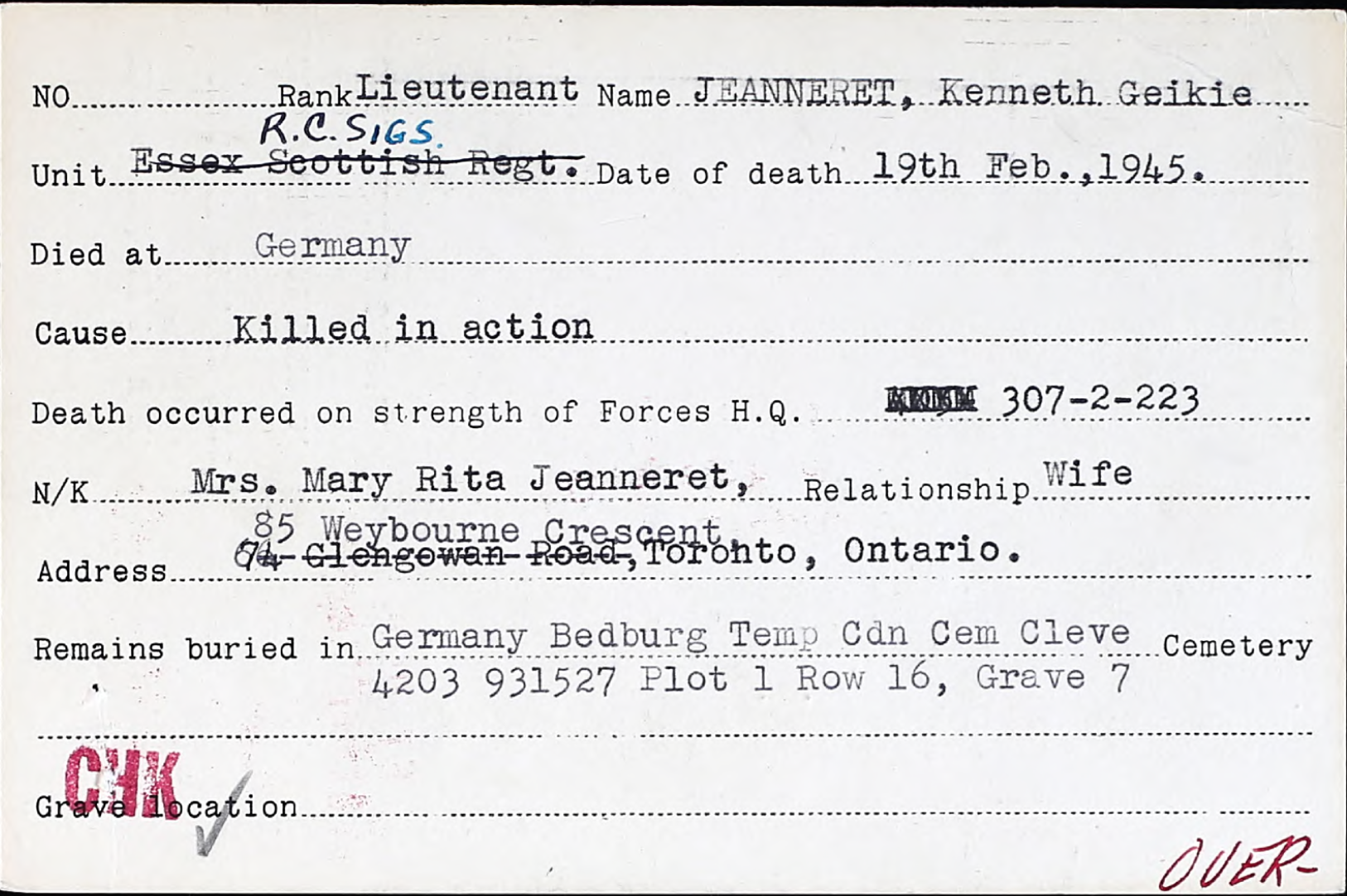
Casualty administration record of Lieutenant Kenneth G. Jeanneret, compiled following his death during Operation VERITABLE. The document shows that his unit was initially recorded as the Essex Scottish Regiment before being corrected to the Royal Canadian Corps of Signals (R.C.C.S.). As a Signals Officer, Jeanneret served with the R.C.C.S. but was attached to the Essex Scottish Regiment. The record also notes his original burial at the Bedburg Temporary Canadian Cemetery (Plot I, Row 16, Grave 7), before his remains were reinterred after the war at Groesbeek Canadian War Cemetery (Grave IX.E.8). © Library and Archives Canada
Today, Lieutenant Kenneth Geikie Jeanneret rests at the Groesbeek Canadian War Cemetery in the Netherlands, in Grave IX.E.8, among more than 2,300 Canadian servicemen who gave their lives during the liberation of the Netherlands and the Allied advance toward the Rhine. To most visitors, his grave is one of the many white headstones standing in neat rows across the cemetery. Yet anyone who reads his personal letters, studies the Canadian newspaper articles, and compares the battle reports of the Essex Scottish Regiment and the Fort Garry Horse will discover far more than a name carved in stone. Instead, a vivid picture emerges of a young lawyer from Toronto, a devoted husband, a loyal friend, and a Signals Officer who remained steadfast in carrying out his duties until the very end. His story reminds us that behind every headstone at Groesbeek lies an individual with dreams, ambitions, loved ones, and a future cut short by war. It is precisely for that reason that these personal stories deserve to be told—and remembered.
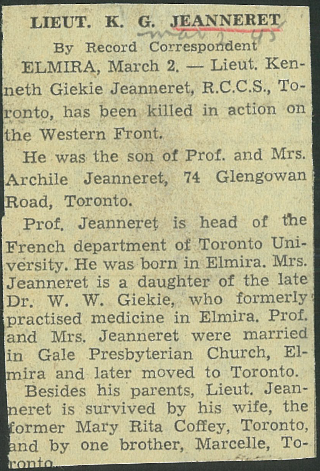
Krantenartikel uit maart 1945 waarin het overlijden van luitenant Kenneth G. Jeanneret wordt bekendgemaakt. Het bericht beschrijft zijn achtergrond als zoon van professor Archibald Jeanneret van de University of Toronto, zijn huwelijk met Mary Rita Coffey en zijn sneuvelen op 19 februari 1945.Newspaper article published in March 1945 announcing the death of Lieutenant Kenneth G. Jeanneret. The article outlines his background as the son of Professor François Charles Archile Jeanneret of the University of Toronto, his marriage to Mary Rita Coffey, and his death on 19 February 1945 during the fighting of Operation VERITABLE. © Canadian Virtual War Memorial
Sources
- Service File of Lieutenant Kenneth Geikie Jeanneret, Library and Archives Canada.
- Casualty File of Lieutenant Kenneth Geikie Jeanneret, Library and Archives Canada.
- Casualty administration and burial records of Lieutenant Kenneth G. Jeanneret, Library and Archives Canada.
- Personal correspondence (Air Letters) of Lieutenant Kenneth G. Jeanneret to his wife, Mary Rita Jeanneret, from the author’s private collection.
- The Fort Garry Horse in the Second World War (accounts of the fighting along the Goch–Calcar Road and at Moyland Wood).
- War Diary, Essex Scottish Regiment, februari 1945.
- War Diary, Royal Canadian Corps of Signals, 1944–1945.
- University of Toronto Memorial Book: Second World War 1939–1945. Soldiers’ Tower Committee, University of Toronto.
- Torontonensis (University of Toronto Yearbook), 1939.